Odell Beckham Jr Never Wear My Jersey in Tour Rides Again Jake Paiul
The people who loved Dion Jordan tried everything to help him, and when everything failed, they deceived him. They said they'd booked him a belated birthday getaway; he'd go home to San Francisco. They'd fifty-fifty bought him tickets to see the Giants, his favorite team. Jordan had passed that summer of 2022 in the dark dried quarters of his house in Chandler, Arizona, grabbing bottles from his liquor cabinet, occasionally chasing the drinks with Ecstasy. He had refused to answer texts or phone calls about how he was doing during his 1-twelvemonth suspension from the NFL for the drug tests he'd failed. But the allure of the Bay Expanse trip and the seats along the third-base of operations line briefly lifted his fog of despondency, and got him to pack an overnight handbag and board a flying with his girlfriend, Paige Pettis.
The couple landed and, while they did sentry the game, they headed afterward to the function of Doug Hendrickson, Jordan'due south agent and Pettis' co-conspirator. Hendrickson had braced himself, but to actually see Jordan, his stained glaze, sometime and smelly T-shirt, disheveled hair? The 25-yr-old looked homeless -- and so far removed from the defensive end Miami had drafted third overall two years before that Hendrickson really feared for Jordan's life.
Come with me, he told Hashemite kingdom of jordan. They walked a couple of blocks and stepped into the gym on Front Street run by the trainer who was more than a trainer, and the real reason for this trip. It was a sparse setup, no weight machines, very little gym equipment. The trainer who was more than than a trainer was in his part in the back. Hendrickson knocked on the door. "Dion needs you," he said.
The trainer looked at Jordan, astonished.
He turned to Hendrickson, nodded and prepare himself to his task.
When Hashemite kingdom of jordan emerged from the part an hr later he knew 2 things. One: He was moving to San Francisco. And 2: He was not leaving the trainer'south side.
EVERYONE CALLS HIM T. Information technology could correspond trainer or teacher, but really it'south a play off his first name, Tareq. Today, one of the last days in July earlier NFL players caput to grooming camp, T busies himself in the Front Street gym he named Empower. And then many people are here. All-Pro Rams corner Marcus Peters sits on an exercise ball in the calisthenics infinite only off the main hall, nodding his head to the hip-hop blaring from the speakers, thumbing a message on his telephone. He came to Tareq Azim in function because Peters' cousin, Marshawn Lynch, trained hither; Azim helped Lynch unleash Brute Mode. Lynch even so refers to Azim as "family," and Peters calls him "large blood brother," generally because of what Azim has helped him realize away from the field. "Information technology own't about ball," Peters says.
Raiders running back Jalen Richard sits next to Peters on a plyometric leap box, staring at the racks of dumbbells confronting the far wall, preparing for the hell that volition be his workout. Two years agone Richard scored a 75-k touchdown against the Saints on his commencement NFL run. What remains as surreal as that afternoon are the conversations he has now with Azim. Accept the previous Sunday. He went to a barbecue joint with Tareq and his blood brother Yossef, a cop who patrols the Tenderloin, San Francisco'due south toughest neighborhood. Tareq started talking almost Afghanistan -- how a decade agone Tareq had stared down Taliban warlords to reclaim his family'southward ancestral lands -- before shifting to a give-and-take nigh the conditions of poverty wherever they are found, the actions they excuse and the lives they tuck. Richard nodded his head. He's from Alexandria, Louisiana, in the fundamental part of the state, and had such a bleak and blinkered childhood that the 75-grand touchdown against the Saints? It was the showtime time either he or his parents had been to the Superdome. "The conversations nosotros have, that I have with T," Richard says, "I don't really have those conversation with nobody else."
Brushing past Richard now is Azim himself. At 36, he still possesses the meaty power he had as a D-I linebacker, and he walks quickly to catch up to Jed York, the owner of the 49ers and a client here. York finished a workout 20 minutes ago and is still in greyness shorts and a black T-shirt. Azim leans in shut and so York can hear him above the clarion music. They are business partners too, York so intrigued by the ethos of Azim's gym that he had a separate Empower congenital within the Niners facility in Santa Clara, for staff and administration. "The best matter about T, he just cuts through everything," York says. "There's no pretense."
As Azim and York navigate the gym, they do so carefully because of all the Englishmen. The place is teeming with them. Yesterday, the coach of England'southward Sevens national rugby club stopped past. He'd heard about Empower, the secrets that athletes acquire here, and with the 7-on-7 Rugby Earth Cup at AT&T Park this weekend, his lads were in need of a place to lift. Brawny rugby players with black jerseys and pale pare are everywhere, squatting in the squat rack and prancing around the heavy numberless, hard against the boxing band, or just standing confronting the wall hither in the calisthenics room, sizing upwards the 6 NFL and MMA guys who are well-nigh to have their orders from Azim.
I catch Tareq's eye every bit he finishes with York and make a face that says, This is basics. His smile says, Just another Tuesday. It'due south truthful. Luke Rockhold, a old UFC champion and the new confront of Ralph Lauren (not joking) is here all week. Gavin Newsom, very likely the next governor of California, will exist here Thursday. Dion Jordan, after meetings and workouts with the Seahawks in Seattle, will be back Friday.
The music gets louder and all the same more aggressive, a cue for the NFL and MMA coiffure to stop stretching. I join them. Because I wanted to feel what makes this place different, Azim had suggested I piece of work out with the pros. I look around me as I stretch my triceps: The room is 30 paces long and FieldTurfed, with mirrors lining the left wall. What will happen hither?
Azim walks before us. He is all broad chest and cauliflower ear and alpha male energy. Hollywood would cast him as a successful D-I wrestling coach. He likes to listen to people and when he at concluding interjects, his honesty is oft bracing. "Take a lap," he says, in the vox of your favorite P.E. teacher. And and so we do, out confronting the cool breeze, past the tech startups and the park where the homeless mingle, so back into the gym and the calisthenics room.
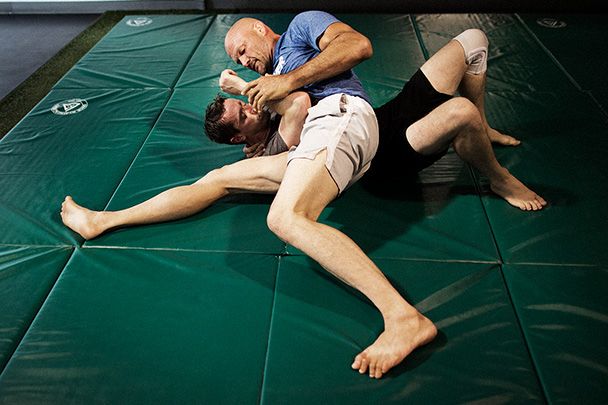
The Empower gym trains athletes across a wide swath of disciplines. Talia Herman for ESPN
We will do a leg conditioning, loftier intensity, using simply our bodyweight. Azim teaches "humility," he says, and if NFL guys (and ESPN writers) struggle to lift fifty-fifty their ain bodies, perhaps they will choice upwards on the deeper lesson of our temporality, how death is coming regardless and if one "prepares for death," one can seize each twenty-four hour period fully, be non just a sack leader only a bully husband, father, brother, homo. For Azim'due south faithful -- and they are "not normal people," he says of the iconoclasts and castoffs of the NFL and combat sports -- the workouts aren't only about getting "comfortable with discomfort" but metaphors on the redeeming qualities of the man condition. Information technology is a threatening bulletin, especially for leagues that ask their athletes to play and hit but never question. It is likewise a message that has allowed Azim to movement from an outsider to the insider'south insider, the sort of guru who turns away more than athletes than he could e'er train and declines, routinely simply as well respectfully, the offers from NFL clubs to come on as a special liaison to players.
We outset with a series of squats, then concord the stance when our butts are parallel to the turf. We stay there, frozen, and from that position Azim tells us to lift one leg and stomp information technology downwardly. Stomp, stomp, stomp. Over and over. The burn down is excruciating. "Go on it upward!" Azim shouts. We grunt. I let loose a gasp of pain. All the same nosotros stomp.
"Fourth dimension!"
It is over. Information technology is not over. The other leg now.
And this is one prepare of four.
We do just-as-hard movements on the floor to strengthen our glutes and hamstrings. Halfway through the workout, I feel empty-headed. Black dots appear on my vision's periphery. I think about how I will not embarrass myself. I will non faint in front of the pros. The dizziness passes.
The hardest exercise is the last. Azim puts medicine assurance on the floor. We are to squat downwards behind the balls and push them across the turf to the far wall. Information technology sounds easy. It is besides incommunicable. My hands ride upwards the leather casing and the heavy brawl loses all momentum and I tumble ahead of information technology and splay across the turf. I endeavour to become the ball moving once more, but information technology's brutal, my legs quivering from the fire, and when I think I've constitute the right position on the brawl, my hands inch up once more. Now I am embarrassing myself.
We push button the medicine ball many times. Some pros struggle too. Earlier my terminal round, I tamp down the frustration and humiliation that had powered my previous attempts. I exhale and written report the ball. I choose a lower position and tell myself to be in concert, my hands and anxiety pushing as 1. I grunt, and this time the ball glides beyond the turf. Azim comes over and kicks the side of his foot against the ball to slow my momentum, something he has washed with Marcus Peters, who's mastered this drill. Like Peters, I'm able to keep my hands low, my hips back. Azim keeps kick, but I cannot be stopped.
I reach the far wall. He smiles at me.
"Skillful!"
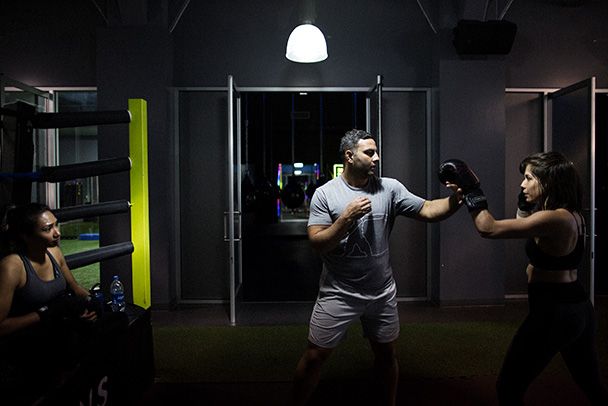
Azim, shown here with clients at Empower, has a lifelong analogousness for boxing. Talia Herman for ESPN
FOR AZIM, EMOTIONAL resilience and fifty-fifty physical strength are born from the moments that apprehensive us. Azim offset learned the lessons of humility as a kid in Concord, in the East Bay. His family ultimately settled in that location as refugees after they'd fled Transitional islamic state of afghanistan. They lived in Section viii housing. Sometimes they didn't have enough food stamps to buy milk. Information technology was quite a dissimilarity to their old lives in Kabul.
Tareq descended from Afghan nobility. His maternal bully-grandfather brought fighter jets from Italian republic and established the Afghan Air Strength. His maternal grandfather, Gen. Shaw Wali, commanded Bagram Air Base of operations and was close to the Afghan royal family. There are photos of the general with Queen Elizabeth. Tareq's parents "grew up with golden spoons in their mouths," he says, part of an Afghanistan in the 1950s and '60s that was open to trade and had a robust press, dorsum when Europe influenced the country's way and many women chose not to habiliment hijabs.
The Communist takeover of the belatedly '70s changed everything. Anyone who stood up to Soviet rule after the coup d'etat was imprisoned, tortured and killed. The Communists came for Gen. Wali in 1979. He said to his wife equally he was escorted out of his house: "Don't turn your back on Afghanistan."
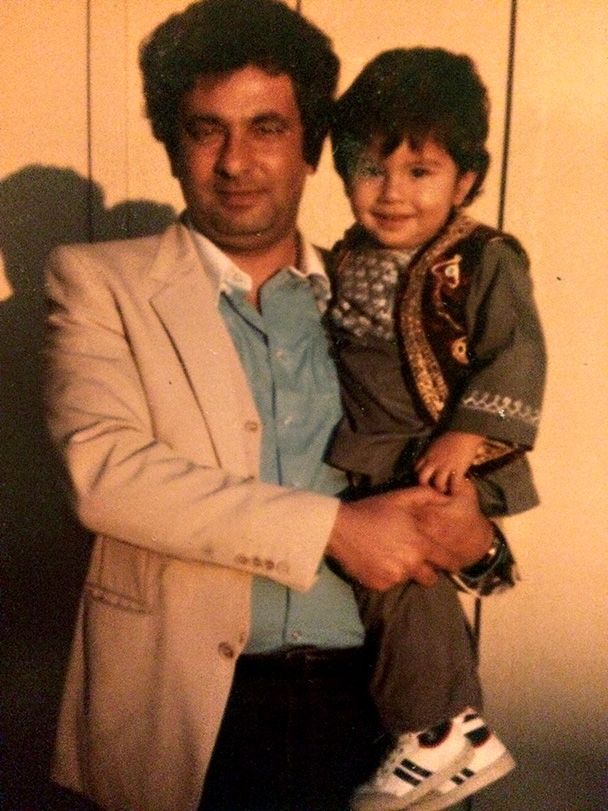
Tareq and his father, Sayed, after the Azim family arrived in America in the early on 1980s. Courtesy Tareq Azim
His family had to, though. They would accept been killed otherwise. But the full general'southward concluding message became family lore, and his daughter Mina kept his words with her every bit she and her married man, Sayed Fazel Azim, raised their three kids in mangy Agree. The couple talked endlessly of going back to Afghanistan, the duty each Azim owed the nation -- lay the bricks for a amend life there, Mina often said -- fifty-fifty as their children acclimated to the States. Dina, the oldest, played volleyball. Tareq and Yossef took up taekwondo before Tareq found battle, then soccer, then rail. In the East Bay's immigrant communities, "I used to become bashed all the time," Tareq says. "'Wait at him: He's doing all the white-boy s---.'"
Tareq needed the distraction. His father had episodes of manic depression. Tareq remembers one time as a boy when he climbed a fig tree. His dad loved figs, and when Tareq had grabbed plenty from the branches, he bundled the gift in his shirt and ran back to the business firm.
"He was sitting on his bed, just sitting there staring straight alee," Tareq recalls. The young son yelled, "Dad! Dad!" merely Sayed kept staring. He wouldn't look at anything but some point on the wall. Tareq, scared, dropped the figs to the floor. He tried kissing his male parent to milk shake him from his trance. When that didn't work, he ran from the room and called 911. The ambulance took Sayed abroad in a straitjacket.
Sayed's mental illness became something -- like the menial jobs he and Mina worked -- that the Azim family simply dealt with. "We grew up similar, 'Hey, give Dad his medicine,'" Tareq says.
Tareq constitute a release in football. He'd come to the sport late, starting as a kicker on the freshman team -- soccer carried coincident benefits -- and discovered he liked striking people more. "I got addicted," he says. With his background in boxing, he had dandy manus-eye coordination and became a fast, ambitious outside linebacker. He dreamed of being the first Afghan-American to make the NFL. He averaged a sack a game his senior year and led the Ygnacio Valley Warriors to the Northern California sectional championship.
After two years at a juco, Fresno State saw promise in Azim simply couldn't settle on where to put him. He moved from linebacker to rushing defensive stop to fullback. The Bulldogs' coaching staff said they'd return him to exterior 'capitalist for his senior year. Just before information technology started, Azim ruptured disks in his spine. The surgery and recovery time consumed almost all of his season. Withal, he remained optimistic: With a skilful pro day, Azim knew he could latch on to an NFL squad.
While Azim trained in the early on months of 2004, his begetter had returned to Afghanistan. Large swaths of the family's ancestral acreage in Kabul, and in the Kunar and Nangarhar provinces, where Tareq'due south family unit was akin to tribal royalty, were existence sold off, often to warlords, and without Sayed'south approval. He had to reclaim it.
Tareq loved his father; Sayed was kind and gentle. Could the crumbling man really stare down a warlord? Would he in his native country take another outburst of the disease that had worsened in united states? Sayed never pressed, never even asked Tareq to join him, but the son knew he had a choice: fealty to Transitional islamic state of afghanistan or to his dreams of the NFL? The question was really the loudest refrain yet of the chorus he'd heard his whole childhood: Will you lay the bricks for others or lay them for yourself?
DAYS AFTER TAREQ graduated from college, Sayed got a call from a number he didn't recognize.
"Hello?"
"Dad. It's Tareq."
What's this, Sayed said? Some Skype number or something?
"No, I'm in Dubai."
Tareq was calling from a telephone at the airdrome. "I arrive in Kabul at 10 a.m. your time."
His younger blood brother, Yossef, had told Tareq not to become. "It's chaos," he'd said. The American-led invasion in 2001 had snuffed out the members of al-Qaida who'd trained in Afghanistan only now, some 2 years subsequently, with America fighting a second war in Iraq, Taliban warlords and other tribal sects had re-emerged, battling over onetime territories. The Afghan government was too weak to end them. It was then unsafe in Kabul at the time, Pulitzer Prize winner Steve Coll wrote in "Advisers S," a clandestine history of the U.S. war in Afghanistan, that when an SUV in a heavily armed American convoy one day accidentally struck a woman wearing a burqa, no soldier stopped to get out. No vehicle in the convoy even slowed to run across if the woman was alive. If American convoys stopped, American convoys risked getting diddled up. The vehicles continued to the aerodrome, where they picked up Hillary Clinton, so a U.Southward. senator and vociferous champion of the rights of Afghan women.
Tareq Azim flew into that same drome almost six months later. He had "bad intentions," he says. He'd learned that some of his Afghan relatives had been the ones to secretly sell plots of his father's acreage. To get the land back, especially from the warlords whose attitude was Try to go me off information technology, "I would react however they acted," Tareq thought. "If they wanted to punch, I would punch. If they wanted to shoot, I would shoot."
After landing on the decrepit runway, deplaning via a rickety ladder, and seeing on the 10-minute bulldoze to his male parent's Kabul estate the effect of 25 years of war -- the bombed-out detritus of "commercial" districts, a woman who begged and held upwardly a starving and possibly dead infant by its ankle -- Tareq was "extremely disgusted with myself," he says. How could he add to this carnage? Wasn't this identify, this much-mythologized identify, which had become the fourth-poorest country in the earth after a war with the Communists and a second with itself and now a tertiary featuring the Americans, wasn't this place also in need of something hopeful, something meliorate, to return information technology to the esteem the Azims had held for it?
Tareq cried in the automobile.
For him, what became equally vital as reclaiming the parcels of land was improving the lives of the people who lived most them. In Kabul, Tareq befriended 12- and 13-year-olds and ane day took them for ice foam. The kids stopped before a certain cake -- Block 12 in Tareq'southward nomenclature, because the city was too bombed out for street names -- and said they couldn't walk farther. A rival gang controlled that street. Cross it, and gang members might bomb your automobile or throw Molotov cocktails through your flat window.
Azim had a thought. The only way people listened to each other, the simply way people had listened to him, as an immigrant in Concur, was through the linguistic communication of sports. If he could get the kids to communicate, he could possibly stanch the period of blood.
That's how Azim came to gear up a neighborhood soccer league, which often played its games within view of Cake 12. The Cake 12 kids, curious, edged closer to the field of play until, one by ane, they joined in. The league spawned from at that place. Neighborhoods taking on other neighborhoods, girls joining the games, Azim going door to door to explain to parents -- who'd lived through the '90s and the Taliban's edicts confronting music, singing and women's rights -- about the benefits of a sport similar soccer. Through these conversations, Tareq heard of a man named Abdul Saboor Walizada, who'd started a separate girls soccer league in Kabul. Azim teamed upwards with Walizada. The girls laughed at their new, obviously American coach, who didn't intendance about the cultural norms that stated men couldn't talk to women who weren't their wives or sisters. Azim talked with anybody, in Dari or Pashto or English, if the girls knew it. He encouraged them on the pitch, joked with them off it, and the new girls league took off, with divisions and age ranks. Suddenly neighboring provinces wanted in. Azim had planned to stay in the country a month, and here it was a year subsequently and the piece of work as Walizada's deputy consumed him. He traveled, he cajoled, he carried out administrative duties until information technology was no longer a girls league at all simply a nationally sanctioned women'southward soccer federation. It spanned a handful of cities and 25 teams.
"I used to stand and watch soccer and recollect, 'Possibly in an afterlife I could play information technology myself,'" says Shamila Kohestani, the first captain of the Afghan women's national team. "It was a great thing ... to finally have a place where nosotros were accepted equally athletes."
And then, in 2006, ESPN called. Girls aligned with the emerging national squad had simply won the Arthur Ashe Courage Award. Could a few players and Azim and Walizada fly to Los Angeles, to be honored at the ESPYS?
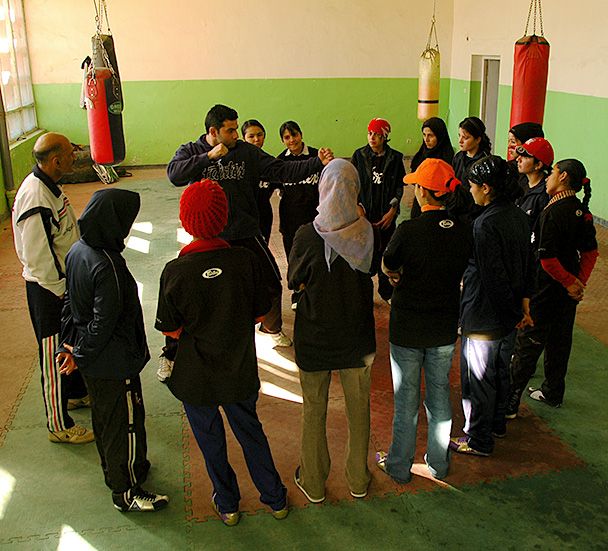
Tareq, preparation young female boxers in Afghanistan, circa 2007. Courtesy Tareq Azim
AFTER THE AWARDS ceremony and parties, and afterward the seven other Afghans wearied their questions virtually America, Azim returned to Afghanistan. It felt increasingly like home. Yes, he'd negotiated with warlords to reclaim his father's land and, aye, violence remained as ubiquitous equally the country'southward abuse, but Afghanistan wasn't just radical mullahs, decease and bribes either. Here he could continue to change perceptions. Hither he could lay bricks, and maybe build something of his own, something even more impressive than the soccer federation.
He had a second, bolder thought. If the proverb were true that empowering a woman liberated a family, what if Azim literally fabricated Afghan women equally powerful as men?
What if he taught them to box?
His friends and extended family unit said it was a terrible idea. Even his female parent, the ane whose lay bricks mantra and strong will lived in Tareq'south favorite photo -- an image of a radiant Mina, enjoying a cigarette in Kunar, next to her AK-47 -- even she thought Tareq had gone besides far this time. In certain provinces, "People don't want girls to go to school," she told him. "How will yous convince them to let girls box?"
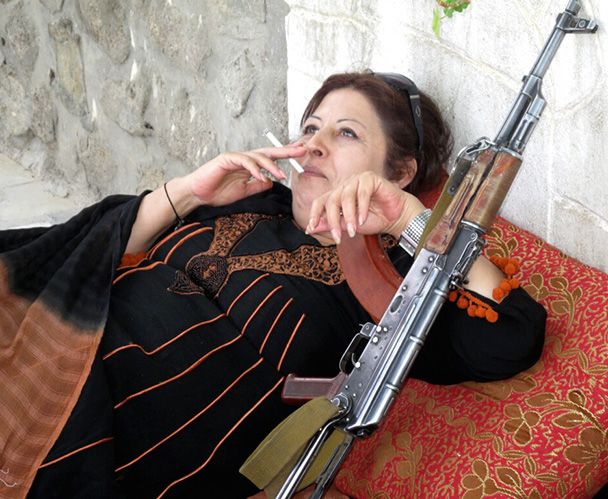
Tareq's mother, Mina, enjoying a fume in the Kunar province of Transitional islamic state of afghanistan. Courtesy Tareq Azim
Withal, he couldn't let the thought go. Its vivid hope lit his days. The confidence he'd had equally a young boxer- -- what if women hither had that? So how to convince everyone? Well, Transitional islamic state of afghanistan ran on tribal politics. Azim would merely have to paint for the largest tribal rulers a portrait of the hereafter he saw. He isolated three leaders, the most menacing of whom was Mullah Wakil Ahmed Muttawakil, a loftier-ranking Taliban politician and former spokesman for the regime'south brutal supreme commander, Mullah Mohammed Omar. If a Taliban official endorsed Azim's idea, who could be against it?
President Hamid Karzai's government had at ane point placed Muttawakil under house arrest for the bloodshed he'd ordered or condoned, a predicament that did not necessarily limit Muttawakil's influence inside the Taliban. Through Azim's growing Rolodex, he discovered Muttawakil lived at present in a guarded compound on the western edge of Kabul.
Azim didn't tell the American diplomatic mission about his plans, much less his family, merely did agree to a request from a documentary film crew, which had learned of Tareq through the ESPYS and wanted to follow him at present. One solar day Tareq and Peter Getzels, a producer and managing director from Washington, D.C., headed out to meet Muttawakil.
They drove to a mountainous nowhere-globe 25 minutes exterior downtown Kabul. Amidst this moonscape they saw men with assault rifles guarding a pocket-sized compound.
Wild thoughts ran through Azim'southward head: What if it all went wrong and he and Getzels were shot in the back? What if they were disappeared? At the same fourth dimension, an equally febrile confidence buoyed him: He could do this. He'd done it before; he'd just been honored for doing the "impossible."
Besides, he thought, the plan had to piece of work. The 1 thing he'd intentionally left in Kabul was a gun.
He and Getzels were led to a room with ruddy carpet and honey seats. Muttawakil appeared, bearded and bespectacled and soft-bodied, in flowing Afghan garb. He looked more like an imam than a hardened political killer.
They saturday down. "I played sports in America," Azim said in Pashto. He had given this moment a lot of thought. "I empathise customs. I understand unity. I understand the power of sports. It's merely not right that our kids don't have opportunities -- or [aren't] able to larn most themselves, [aren't] able to build confidence..."
Muttawakil nodded. The suspicion in his face softened merely a bit. The pair traded anecdotes about Transitional islamic state of afghanistan and Islam in Dari and Pashto. Ane hour passed, then two. Azim'due south fear transformed little past footling into something like hope as they moved into their third hour. Muttawakil said the Taliban, despite its reputation, wanted social progress, and and so would not interfere with Azim's wishes or harm him personally. He asked only that immature women follow Sharia constabulary and dress conservatively: no sports bras in the ring. Azim agreed. Muttawakil put his hand on Azim's and said the female boxing program would be a "symbolic" testament to a new Transitional islamic state of afghanistan. "Go," he said, his face alit.
Azim opened the first gym on the grounds of Ghazi Stadium in Kabul, where the Taliban in the '90s had beheaded dissidents. He wanted "to bear witness to the world that Afghanistan is ready for social alter."
Without the assistance of foreign governments or the guidance of NGOs, he worked with provincial governors and everyday Afghans to help open 36 more gyms, with around 250 girls and young women grooming and sparring regularly. One of them, Sadaf Rahimi, became the first female boxer in Transitional islamic state of afghanistan invited to the Olympics. "I wanted to testify that Afghan girls could exercise everything, besides," she told the international media.
It should accept been a fairy-tale catastrophe. Merely ten days earlier the London Games, the International Boxing Association revoked Rahimi'south Olympic invitation, citing a curious merits almost her lack of preparedness. (Azim thought the revocation had more than to do with Afghan politics and the anger from hard-lined conservatives that the boxing plan had induced.) Fifty-fifty before the Rahimi mess, Azim saw the boxing federation fall casualty to what-about-me infighting and piffling abuse. "Information technology broke my heart," Azim says. "When all that hijacking southward--- began, I learned to not call back that anything [in Afghanistan] was mine."
He realized that perhaps merely in u.s.a. could his bricks build a lasting structure.
WHAT STAYED WITH him when he returned to the Bay Expanse in 2008 was that meeting with Muttawakil. He, Tareq Azim, an American civilian, had really met with a leader of the Taliban -- unarmed! -- and gotten the guy to anoint his progressive idea. Azim had found a way to stare through his fright and reach something not even his mother thought possible.
What else would people exercise when fright no longer bound them?
He worked in diverse Bay Surface area gyms to test this question, and footling by little his customer list grew until information technology included MMA champion Jake Shields and football game players from Oakland, Raiders QBs Charlie Frye and Bruce Gradkowski. They each plant that the inaugural session with Azim did not comprehend the proper form on demote press. It was a sit-downwards that went something similar this:
Azim said they had a "disease of fear." To move past information technology, he told his athletes to offset imagine the worst that could happen to them now, today. Invariably the athletes said they could die. Azim told them that they'd die anyway and that they needed to fix for it, much as he had in Transitional islamic state of afghanistan. By preparing for decease, they could fully realize the souvenir that was life, and live as fully realized people, not but myopic professional athletes. None of this would exist easy. To move beyond fear, they -- tough NFL players and combat sport pros -- had to first acknowledge they were fearful, which meant assuasive themselves to be vulnerable, which meant being honest with themselves and everyone who walked into the gym. And if they sought this level of truth, they could, as the Quran put it, be fantabulous in everything they did.
Gradkowski and Frye were in awe. They went back to Raiders passenger vehicle Tom Cable: Y'all gotta meet this dude. Cablevision did. No one in the NFL talked like this. Azim was training and then much more than players' bodies. Word spread along the West Coast and ultimately reached the Seahawks coaching staff. They had a running dorsum who was underperforming. Peradventure that guru guy in San Francisco could help.
Azim had opened his own gym, Empower, and within 30 minutes of Marshawn Lynch meeting him there, Lynch pounded his breast and alleged, "My brother!" The socially conscious Lynch already was living what Azim was preaching, and so of course he would follow The Game Plan, what Azim's acolytes now called the personalized goals that emerged from that first sit-down. Over the coming seasons, the trainer who was more a trainer helped pull out the All-Pro inside Lynch. That left hook of a stiff-arm that went viral against the Niners' Patrick Willis in 2013? Born out of the boxing Lynch and Azim did in Empower.
Lynch'due south trip to Haiti in 2016, to provide relief subsequently the country's massive convulsion? Lynch had always been charitable -- that's why he and Azim clicked -- just the trainer says, "I try to normalize all the non-normal dreams of athletes." The pair got so close that Marshawn began to refer to Sayed Azim as "my dog," so shut that when Lynch needed hernia surgery in November 2015, Tareq dropped his vacation vacation plans and rehabbed Lynch every day for ii and a half weeks, through Christmas and New Twelvemonth'south, to get the running back ready for the Seahawks' playoff game against the Panthers.
"Tareq wants to exist the i to accept on the burden of other people'southward problems or issues," says his wife, Megan, who met Tareq in 2012, as Empower started to depict the attention of Lynch and other stars like Justin Tuck and Barry Zito. "And Tareq also wants to be the one who alleviates any of those situations."
One pro would test him more than whatever other.
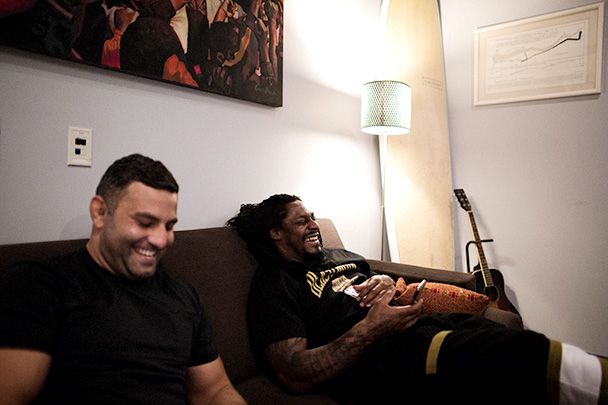
Azim and Lynch, in Tareq'southward office at Empower. Talia Herman for ESPN
WHEN AZIM "GAME PLANNED" Dion Jordan in the summer of 2015, "You lot could tell he was broken," Azim says today. "You could tell he hadn't loved himself for a long time." A lot of athletes hung at Empower before or later on their workouts, merely Azim mandated information technology of Jordan. "With Dion it was an 8-60 minutes shift," Azim says. Get to the gym at the kickoff of business. Nourish meetings with Azim, "only to hear what'due south up: how I sell, how I piece of work, how I build relationships." Then train. Get massaged and stretched. Lunch. AA. Then back to Empower for more meetings. "The gym was like my second home," Jordan says. As the weeks turned into months then into years, Jordan chose as his actual dwelling house a rented apartment just down the street from Empower.
"With Dion," Azim says, trying to find the words, because while he has a familial relationship with his athletes, something else developed with Jordan, "his level of dependency and appreciation helped me feel actually valuable." Hither at last was the calling equal to Azim's ambition, equal to his desire to give and not take the results ruined past exterior forces. Getting Jordan back to the field -- it was almost every bit if Azim had found his life's work.
"I try to normalize all the not-normal dreams of athletes."
- Tareq Azim
The bond deepened. Azim said they had to practice a good act a day. One afternoon he and Jordan went to Subway and bought 100 sandwiches and collection all over San Francisco, delivering them to the homeless. They read a chapter of a book each 24-hour interval. One of their favorites was "Purification of the Heart," a treatise by Islamic scholar Hamza Yusuf. "Nosotros of the modernistic world," Yusuf wrote, "are reluctant to ask ourselves -- when we look at the terrible things that are happening -- 'Why do they occur?' And if we ask that with all sincerity, the answer volition come resoundingly: 'All of this is from your own selves.'" Azim asked Jordan to visualize his return to the NFL, a once laughable premise -- the world outside Empower saw Hashemite kingdom of jordan as perhaps the biggest bust in league history -- but it was an idea that became more than rooted in reality with each passing day. "Set the tempo and the standard for your first game back," Azim told him. "What volition it feel like when you go a sack?
"Everyone volition know who you are."
Jordan smiled. "It's a daily claiming to exist better," he says. "To be a smashing son, brother, beau ... but I've learned that'south the stuff that's worth it."
Azim wasn't surprised when the Seahawks acquired Jordan earlier the 2022 season. Genu injuries derailed the defensive finish'south debut, merely when it came, in Week ten, the venue seemed plumbing equipment: in Arizona, against the Cardinals, 30 miles from that darkened home that Jordan had in one case refused to get out. Midway through the fourth quarter, Jordan balderdash-rushed Cardinals left tackle John Wetzel and knocked him flat on his ass, then pulled downwards quarterback Drew Stanton for the sack.
"It has been the longest of long roads," NBC analyst Cris Collinsworth said on air.
After the game, on the charter motorbus, Hashemite kingdom of jordan took out his telephone and FaceTimed Azim. The trainer could barely make out Jordan's face, the bus was then dark, but he could see Jordan's smile.
"We did information technology, T. We did it."
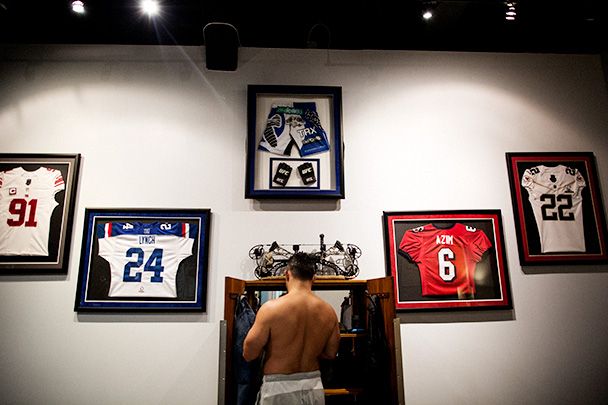
The walls of Azim's office are adorned with jerseys of the athletes he has trained over the years. Talia Herman for ESPN
AZIM SITS AT his desk, hunching over his laptop in the mesh shorts and T-shirt that are his business attire, when his phone chirps with another asking to FaceTime from Jordan. It'south Wed afternoon, one day after my workout with the pros and a few hours after a high school football team trained nether Azim, and Marcus Peters told the panting players equally they recovered to "get uncomfortable."
"Wassup, bro!" Azim says now to Jordan, who on the screen is shirtless and seems to have non long agone finished his own conditioning in Seattle.
Jordan smiles. "Sup!" They've already talked once today, when Hashemite kingdom of jordan relayed the news that the NFL had decided to no longer randomly drug exam him, some other sign of how far he has come since 2015.
Both men would dear nothing more than than to exist together every hour in these concluding days earlier grooming camp. A month earlier, every bit the Seahawks wrapped their jump organized team activities, Azim floated the idea of Hashemite kingdom of jordan staying in Seattle for a few weeks. "Let them know what I know," he'd said. Jordan had finished 2022 on a tear-iv sacks in 5 games-just if the Seahawks coaching staff had doubts about the sustainability of this new Dion Jordan, "Permit them autumn in honey with you besides," Azim told him. "Let them respect you. Let them believe in you."
So Hashemite kingdom of jordan had stayed in Seattle -- merely the dependency had continued. He messaged with Azim all the time. Azim loved information technology as much as Hashemite kingdom of jordan did. Minutes earlier Dion FaceTimed him, Azim had said to me: "Plain my ego and just my desire of wanting to be around my people, I'one thousand similar, 'F---. I wish he was here.'" He said he was looking forward to Friday, when Jordan would fly dorsum to San Francisco to finish his summer grooming at Empower.
On FaceTime now, though, Jordan is anxious. There's something he wants to broach, but it takes a while to say:
He doesn't know if he should come back to Empower this weekend.
"Oh," Azim says.
Jordan backtracks. He will if T wants. It'southward simply the tight schedule ... and so Jordan is stumbling again, unsure of himself. "What do y'all think?"
The prospect of not seeing Dion before the season stings Azim. Equally Jordan's consigliere, though, the question is frustrating. Jordan has to offset beingness the CEO of his life. They've talked almost this.
"Well, what do you think?" Azim asks.
Jordan mutters something most logistics and difficulty and then in his restless feet is a plea they both understand: If you lot want me down in that location, T, simply say the word.
"Stay upwards there," Azim says, trying not to grimace.
Since they won't see each other for a while, Azim asks if anything ails Jordan.
"My knee joint," he says. He had a minor surgery ii months before and complains now about his "get offs": a 50-thou, down-and-dorsum run used to examination quickness and agility. Jordan sends Azim a video of one such run. He wants to know if, on that corner turn, his genu is "firing" correctly.
Azim watches the video. "Dude, you await great on film." Afterward a moment: "Is information technology physical or mental?"
Azim suspects it's mental.
"It'southward concrete," Jordan says.
"All correct," Azim says, not assertive him, but wanting to see if Jordan can stare through this fright about his genu -- probably a proxy for his fear about remaining in Seattle this calendar week -- and detect his fashion to the answer, a fragment of a deeper truth that keeps alluding Jordan.
"Walk me through why information technology's physical."
Jordan says he feels information technology could be in his hips.
Azim nods his head. "Have you lot been doing your hip activation?" It'due south a serial of movements -- a workout, really -- to get Jordan's legs moving with no wasted endeavour.
Hashemite kingdom of jordan says he hasn't been doing it as often every bit he should.
"So it sounds like at that place'south a lot more than on your knees," Azim says, "because your hips aren't cooperating with your feet."
"Yeah, y'all're right," Jordan says, liking that answer.
Azim stares at Jordan. He gives away zippo.
In the cease, bricklaying is a funny business. For three years, yous tin stack bricks with someone you lot love. But as the edifice rises before you, the best you've always built, yous realize the building that will matter more is the one your friend has yet to construct, alone.
Azim lets the moment drag out.
Jordan frowns. "I also got to become it in my head that I'm fine."
Azim tries to stay as calm equally he tin.
"OK, cool," Azim says at concluding, in a vox he hopes is level.
Moments later he signs off with Jordan, and smiles.

Kix is a deputy editor for ESPN The Magazine and ESPN.com. He can be reached at paul.kix@espn.com.
Source: https://www.espn.com/espn/feature/story/_/id/24997294/the-story-nfl-trainer-tareq-azim
0 Response to "Odell Beckham Jr Never Wear My Jersey in Tour Rides Again Jake Paiul"
Post a Comment